

It’s a bit odd to say that I have a favorite insane asylum, but it’s true. As someone who researches, writes, and even tours these historic mental health centers, how can I not? Each asylum is unique in its landscape, patient population, and the decisions that led to its grand opening. However, reasons for patient admission are more consistent across the board than folks realize.
Over the last ten years, I’ve had the privilege of examining actual insane asylum registers — ledgers that store vital information on who is admitted, for how long, and why. Many ledgers are locked-up behind restrictive privacy laws, some are digitized, and others are lost to time. What surprises me most about these books is how honest hospital staff was with their biases, prejudice, and stigmatized view of mental illness.
We can understand, in retrospect, that these entries reflect a bygone era riddled with minimal understanding of how the mind works. Psychosis and melancholia could be labeled “demonic” in nature, dated signifiers that the afflicted person had moral shortcomings. Normal hormonal changes, personal vices, and postmortum grief were often deemed excessive and harmful to not only the patient, but society as a whole. Politics and social status played an unnecessary role in the medical well-being of private citizens, shuttering those categorized as “imbeciles” or “retarded” behind institutional walls, never to experience what it meant to live a meaningful life.
Intentions can be good — great, in fact — but the execution is where the stain on our nation shows. We built grand palaces to showcase medical innovation and feats of engineering simply to confine upwards of 1 million Americans.1 The therapeutic blueprint of physician Thomas Story Kirkbride (who I call the “Godfather” of insane asylums) became twisted by eugenics and utilized for wrongdoings in the wake of electroshock, lobotomies, and psychiatric medication.
My favorite asylum, St. Elizabeths in Washington, D.C., was not only a participant in these trends but also a leader. As the first federal psychiatric facility, as well as one of the earliest examples of Kirkbride’s plan, it had a lot to prove due to its experiment in government funding. Using its original admission registers, let’s examine why these citizens were locked away.
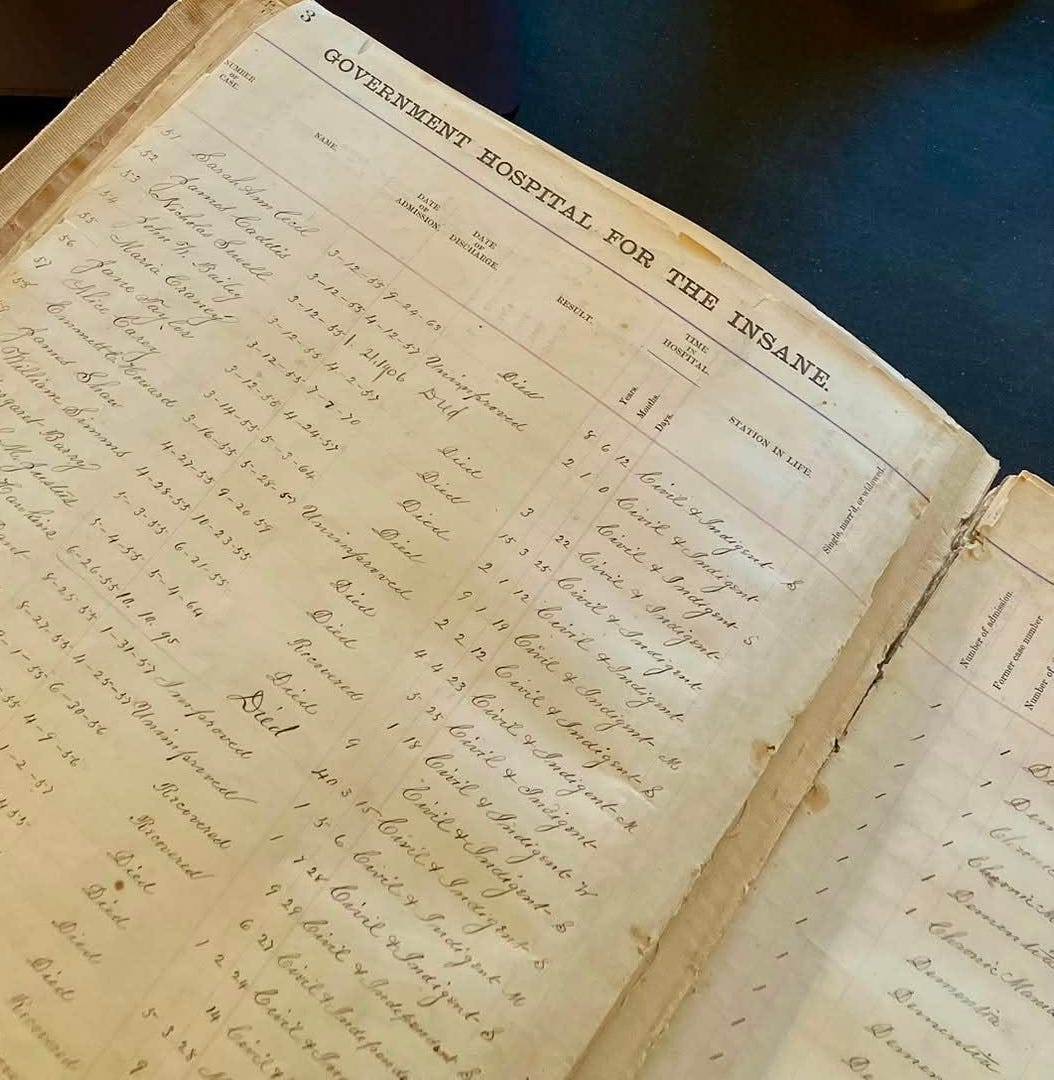
Opened as the Government Hospital for the Insane in 1855, the building now stands gutted and a shell of its historic self as headquarters for the Department of Homeland Security. “Mania” (psychosis or irritability), “melancholia” (depression), and “dementia” (often catatonia or lack of self-care) were the most common causes of institutionalization. Degree of illness was also often noted: acute, chronic, episodic, or periodic.
Here are some rather interesting reasons for admission that I saw within the original registers housed at the U.S. National Archives from 1855-1890:
A 25-year-old Civil War soldier admitted during wartime in 1864 due to one month of “melancholia.” He was never released and died in 1909, since the war inside his head was never over.
A 30-year-old German immigrant admitted three separate times beginning in 1870 for “periodic mania.” Each time he was released, he was marked as “improved.”
A 14-year-old girl admitted in 1881 due to “acute mania” that occurred for 6 months, only to die there in 1936 never having left — 6 months of what could have been puberty shut her in an asylum for the rest of her life.
A 24-year-old U.S. Army soldier admitted in 1883 for “nostalgia” died at the asylum in 1919. We now understand that post-traumatic stress disorder (PTSD) was categorized in the 19th Century as a cardiac condition until World War I, when it was rebranded as a nervous system affliction.
A 22-year-old man admitted in 1885 for experiencing 22 years of “imbecility.” You read that correctly.
A 38-year-old married woman admitted for three months in 1883 due to “acute melancholia” caused by “lactation” that she experienced for three weeks.
Some other reasons for admission are not as clear-cut as these more obvious signs of poor mental health or easily-identifiable psychiatric conditions. We can trace symptoms like “chronic mania” caused by “intemperance” possibly to a modern-day mood disorder, just like “senile dementia” caused by “old age” is a sure sign of Alzheimer’s. Other reasons are unique to the time period, language of the era, or social stigma of the age and make us question why said person was ever admitted to a psychiatric facility. Couldn’t they have treated these concerns elsewhere?
“War excitement” causing psychosis or melancholia at the start of the Civil War
“Acute melancholia” caused by “business troubles” or “business reverses”
“Acute melancholia” caused by “domestic infidelity”
“Acute dementia” caused by “masturbation” (only in the case of male patients)
“Suicidal mania” due to “blindness”
“Acute melancholia” caused by “influenza”
“Acute melancholia” inflicted by “heat strokes” or “sun strokes”
Some admission entries are just plain insulting to our 21st Century morals: “loss of children, overwork, head or brain injury, childbirth, use of narcotics, cardiac disorder, poverty, and hardships.”
If you read any of these reasons and thought to yourself, “Hey, that’s me,” then congratulations — you would’ve been admitted to an insane asylum! In today’s world, this just wouldn’t happen. We have so many social programs and care availability to warrant at-home or outpatient treatment. Even more, much of these conditions would not be treated as psychiatric. While individual therapy may be prescribed, many of these issues or situations are considered temporary or manageable in our times through early intervention, support, accommodation, and medication.
Well, what do we do with this information? It’s quite depressing and infuriating. Psychiatric hospital historians use admission registers, much like general hospital files, to decode the past. What did they believe in? How did they treat their most vulnerable? What care options were available?
Maybe it’s comforting to know that your particular situation is more common than you think — that someone from 150 years ago also faced similar problems or setbacks in life. When we examine a ledger like this, we not only see society reflected on its pages but also ourselves.
Madeline Feierstein is an Alexandria, VA historian and founder of the history education company Rooted in Place, LLC. Madeline is the Education Department Manager for Emerging Civil War and has written for Emerging Revolutionary War, Civil War Monitor, and the National Museum of Civil War Medicine. She leads significant projects on the history of hospitals, prisons, and wartime America. She is the author of Occupied Alexandria: How the Civil War Transformed a Southern City (History Press, 2026). Madeline holds a Bachelor of Science in Criminology from George Mason University and a Master’s in American History from Southern New Hampshire University. Follow her on Instagram and explore her research at www.madelinefeierstein.com.
This is not a verified statistic, but a realistic one. If at least 30 states institutionalized a minimum of 25,000 people — that’s 750,000 Americans already.